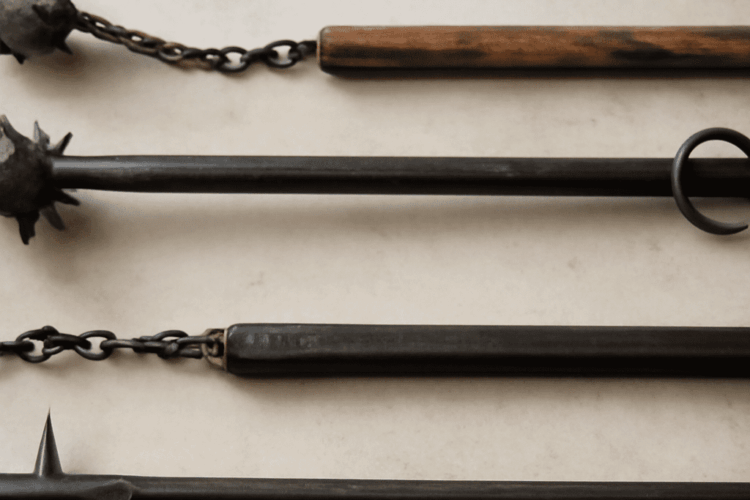
In the realm of game design, particularly in RPGs and strategy games, weaponry plays a crucial role in defining gameplay dynamics. Two medieval weapons that often capture the imagination of players and developers alike are the mace and the morningstar. Both weapons, while similar in appearance, serve distinct purposes and can significantly impact gameplay strategies. This article delves into the nuances that differentiate a mace from a morningstar and explores their implications in gaming, especially within racing modes.
Understanding the mace and morningstar
The mace and the morningstar are both bludgeoning weapons that date back to medieval times. Despite their similarities, they have distinctive features that set them apart. A mace typically consists of a heavy head made of stone, metal, or wood attached to a solid shaft. It is primarily used to deliver powerful blows, capable of crushing armor and bones alike due to its weight and force.
In contrast, the morningstar is characterized by a spiked head, often made of metal, which is also attached to a shaft. The addition of spikes makes the morningstar a more lethal weapon, capable of piercing as well as bludgeoning. This dual capability allows it to penetrate armor more effectively than a mace.
Comparative analysis: Mace vs morningstar
When comparing a mace vs morningstar, the primary considerations are their design, purpose, and impact on combat. The mace’s design focuses on delivering maximum blunt force, making it ideal for breaking through armor. It is simpler in construction but highly effective in situations where sheer force is required.
The morningstar, with its spiked design, offers versatility. It can cause significant damage not only by bludgeoning but also by penetrating. This makes it more adaptable in combat scenarios where both force and precision are necessary. Another key difference lies in the handling; the spikes on a morningstar can require more skill to wield effectively without injuring oneself or allies.
Impact on gameplay and strategies
The choice between a mace and a morningstar can drastically influence gameplay and the strategies players employ. In game design, each weapon’s attributes can be modeled to emphasize their historical roles. The mace can be portrayed as a weapon for heavy, slow attacks that deal substantial damage to armored foes. This can encourage players to adopt a more defensive strategy, focusing on timing and positioning to land powerful hits.
Meanwhile, the morningstar might be favored by players who enjoy versatility and precision. Its potential for both blunt and piercing damage allows for a mix of aggressive and defensive tactics. In gameplay, morningstars might be used to exploit weaknesses in an enemy’s armor or to apply pressure in close quarters combat, encouraging more dynamic and fluid combat styles.
Incorporating these weapons in racing modes
While traditionally associated with combat, the integration of weapons like the mace and morningstar into racing modes can introduce innovative game mechanics. In these scenarios, the focus shifts from direct combat to strategic use of weaponry to gain advantages during a race.
For example, a mace could be utilized to create obstacles or temporarily disable opponents’ vehicles, leveraging its blunt force in a non-lethal way. This introduces an element of strategy, where players must decide when and how to deploy such capabilities without losing momentum.
On the other hand, a morningstar could serve as a tool for precision-targeted strikes, perhaps allowing players to dismantle specific parts of an opponent’s vehicle. This requires players to balance their racing skills with strategic weapon usage, adding layers of complexity to the racing experience.
Ultimately, the inclusion of these weapons in racing modes challenges developers to think creatively about their application, drawing on their historical characteristics while reimagining their role in a modern gaming context.