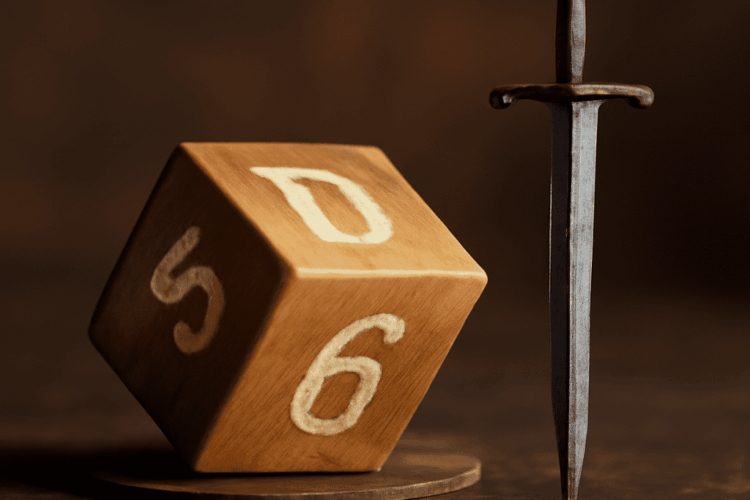
In tabletop role-playing games (RPGs), dice rolls decide everything from the outcome of daring sword strikes to the creation of memorable characters. Among the most iconic is the 3d6 roll: a simple but influential mechanic that shapes probability, gameplay, and the history of the genre. Whether you’re building a new character or resolving skill checks, understanding 3d6 enhances your command of game systems and the stories you help weave.
What does 3d6 mean in tabletop RPGs?
The term 3d6 is shorthand found in nearly every major RPG rulebook, and it stands for rolling three six-sided dice together and adding their results. In this notation, the “3” refers to the number of dice to roll, “d” stands for dice, and “6” signifies that each die has six faces, numbered one through six. So, a 3d6 roll produces a total between 3 and 18.
This method isn’t just random chance; it’s a deliberate design choice for many classic RPGs, most notably early editions of Dungeons & Dragons, where character ability scores were generated using the 3d6 roll. The result is a bell-shaped or normal probability curve, making middle values (like 10 or 11) far more common than extremes (like 3 or 18). This “curve” gives characters an average but not guaranteed set of abilities and makes truly heroic or hapless results rare and exciting.
In addition to character creation, 3d6 rolls are used for skill checks, random event tables, and damage calculations in various systems. Rolling 3d6 is a core part of the RPG experience, especially in games that value both predictability and the thrill of chance.
Understanding what 3d6 means—and why it is used—gives players and game masters a vital tool for navigating character growth, narrative twists, and the balance between luck and skill. It’s more than math; it’s foundational to the game’s feel and fairness.
How to roll 3d6 and interpret the results
Rolling 3d6 is straightforward, but interpreting the result depends on the context within the game. Here’s a step-by-step guide to rolling and using 3d6 in typical scenarios:
- Gather three six-sided dice. These can be any standard d6 dice, often found in board games or RPG starter sets.
- Roll all three dice at once. Let them land flat on the table so each die shows a single number between 1 and 6.
- Add the results together. For example, if your dice show 4, 2, and 5, the total is 11.
- Apply any relevant modifiers. Some games include bonuses or penalties, such as adding +2 for a character trait or subtracting 1 for a penalty.
The resulting sum is then used according to the rule the GM (Game Master) has asked for. In character creation, the total often becomes an ability score—such as Strength, Intelligence, or Dexterity—directly affecting your character’s effectiveness in the game. For skill checks, the 3d6 roll is typically compared against a target number: if your total meets or exceeds this threshold (often including modifiers), you succeed; otherwise, you fail.
But what if multiple characters are rolling 3d6 at once? Each result stands alone: one character might roll an 8 and struggle, while another rolls a 15 and shines. In some systems, you might roll 3d6 for random events or encounter tables, where each possible outcome is mapped to a specific number on the 3–18 scale.
Interpreting 3d6 rolls is about more than just math: it’s about understanding context. A roll of 10 might be average for a new character, but in a high-stakes moment, every point can matter. For creative GMs, a remarkable roll can become an opportunity to shape the story or reveal new challenges.
Probability and statistics of rolling 3d6
The beauty of the 3d6 roll lies in its underlying probability distribution. Unlike a single d6, which gives an even 1-in-6 chance for each face, rolling three dice and adding them together creates a bell curve, or normal distribution. This makes certain totals much more likely than others, and players quickly learn to expect “average” results but hope for extremes.
Here’s how it works: the lowest possible sum is 3 (rolling three 1s), and the highest is 18 (three 6s). However, the odds of these results are exceedingly rare—only 1 way in 216. In contrast, the most probable rolls are 10 and 11, each of which can be achieved in 27 out of 216 possible combinations, giving them about a 12.5% chance each. The chance of rolling any given sum gets higher as you approach the middle and lower at the extremes.
This curve has real effects in play. Since average numbers appear most often, characters tend toward balanced abilities, with statistical outliers adding flavor but not dominating the group. A table of 3d6 probabilities shows that only about 9.7% of rolls will be 16 or higher, making truly exceptional scores stand out. When this mechanic is used for skill checks, it rewards modest bonuses—since even a +1 modifier can noticeably increase a character’s odds of success near the top of the curve.
This statistical structure is why many games choose 3d6 for ability scores but use single dice (like 1d20) for other checks: it naturally produces a party of characters with realistic, varied abilities while reserving spectacular results for truly rare moments. Understanding these chances helps players make informed decisions and appreciate the elegance behind the dice.
Common uses of 3d6 in popular RPG systems
The 3d6 mechanic is a classic for a reason: it appears in some of the most influential role-playing games ever published. Its most famous use is in early editions of Dungeons & Dragons, where players rolled 3d6 for each ability score—Strength, Dexterity, Constitution, Intelligence, Wisdom, and Charisma. This set a baseline of realism and variety for all future RPGs.
Other games have adapted the roll for core mechanics. The GURPS (Generic Universal RolePlaying System) system uses 3d6 for virtually all action resolution. In GURPS, players roll 3d6 and try to roll under their skill level, making every modifier matter and tightly controlling the odds of very high or low results. This method rewards skillful character design and tactical play, while keeping “critical” outcomes rare and dramatic.
In Tunnels & Trolls, 3d6 is a frequent roll for weapon damage and saving throws. Many indie games and retro-clones pay homage to this classic mechanic, citing its balance and approachability. Even modern systems sometimes turn to 3d6 for special checks, loot tables, or events where a bell-curve result is desired.
Whether you’re rolling up a new fighter in an original D&D campaign, resolving a GURPS skill challenge, or generating random events, the 3d6 roll is a reliable, transparent, and time-tested mechanic. It continues to inspire designers seeking a blend of chance and predictability that keeps RPG tables fair, exciting, and memorable.